If you’ve ever typed “what is diabetes” into Google late at night,
maybe after a worrying symptom or a relative’s diagnosis, you’re not alone.
Most answers are either too clinical or too vague.
So let me explain it the way I’d explain it across a kitchen table.
What Is Diabetes, Exactly?
Diabetes is a long-term condition that changes how your body turns food into energy, as the CDC puts it.
Here’s the everyday version.
Most of what you eat becomes glucose, a type of sugar.
Your pancreas makes insulin, which works like a key that lets glucose into your cells.
With diabetes, you either don’t make enough insulin or your body can’t use it properly,
so the sugar stays in your blood.
If anyone asks what is diabetes in one line, that’s it: too much sugar in the blood, for too long.
Types of Diabetes
Once you know what is diabetes, the next thing to learn is that it comes in more than one form.
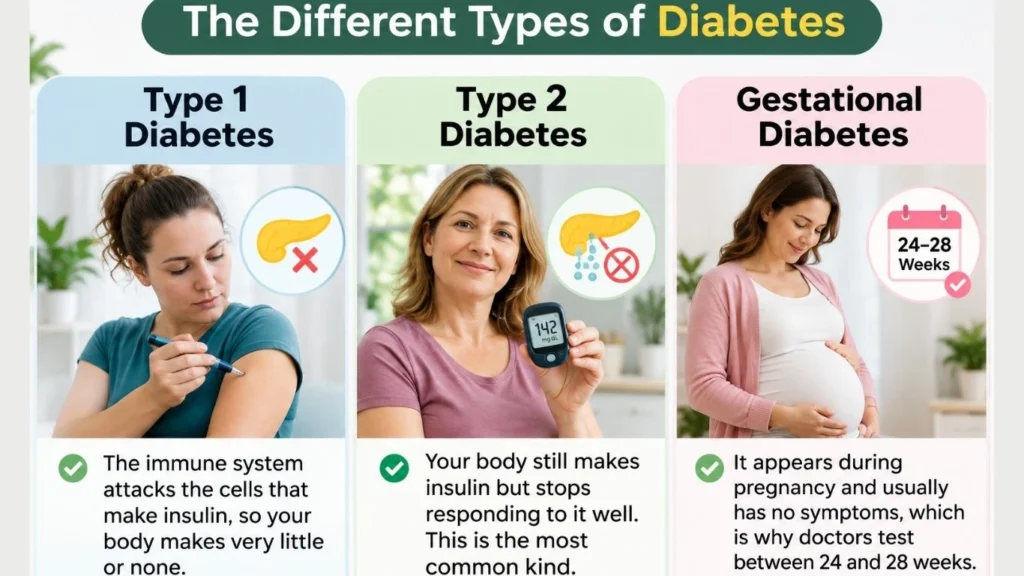
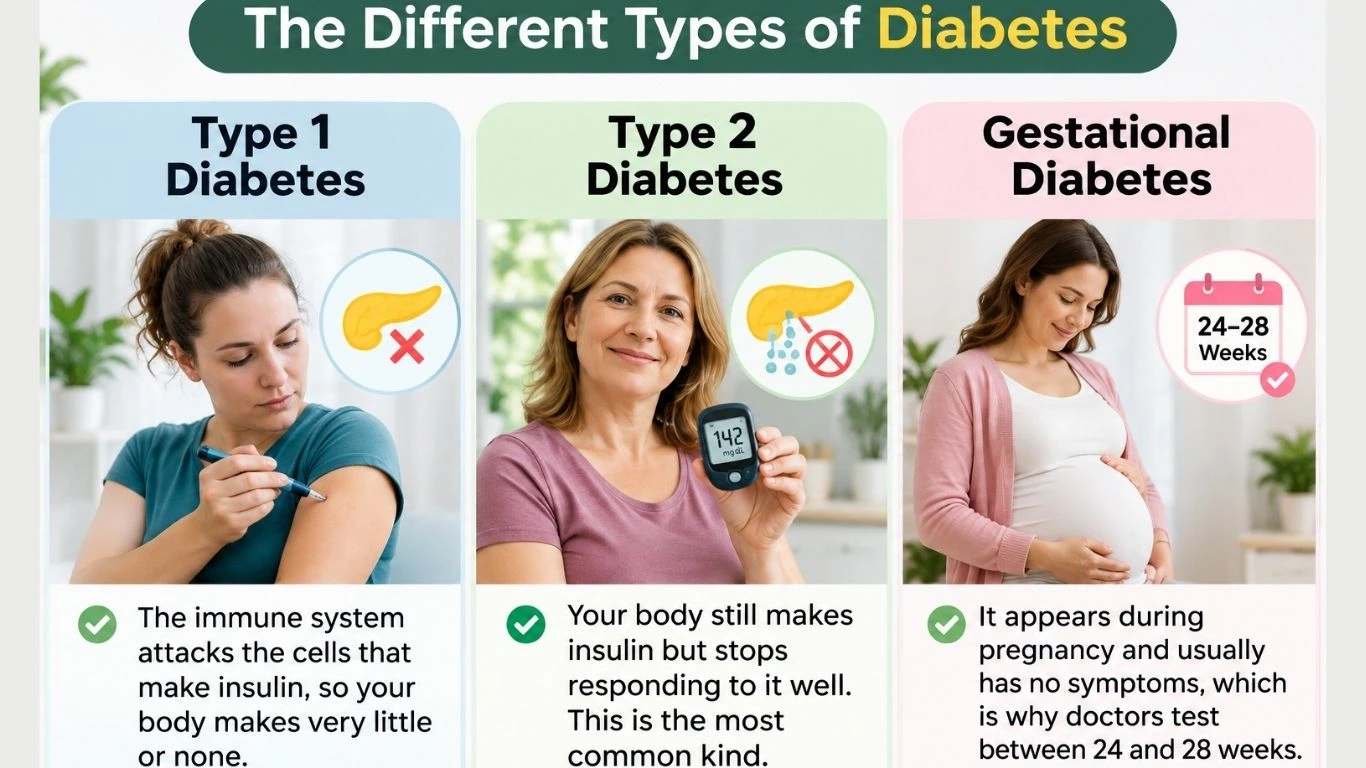
- Type 1: The immune system attacks the cells that make insulin, so your body makes very little or none.
- Type 2: Your body still makes insulin but stops responding to it well. This is the most common kind.
- Gestational: It appears during pregnancy and usually has no symptoms, which is why doctors test between 24 and 28 weeks.
There’s also prediabetes, where blood sugar is higher than normal but not yet in diabetes territory.
Think of it as a warning light.
Symptoms of Diabetes
Knowing what is diabetes is one thing.
Spotting it is another, because the signs are easy to brush off.
Common ones include:
- Peeing more than usual
- Feeling very thirsty or hungry
- Losing weight without trying
- Feeling tired or irritable
- Blurry vision
- Frequent urinary or yeast infections
Type 1 tends to arrive fast, sometimes within weeks.
Type 2 creeps in over years, and plenty of people have no symptoms at all.
Slow-healing cuts, dark patches of skin on the neck or armpits, and tingling in the hands or feet can all be clues.
Causes of Diabetes
Understanding what is diabetes also means asking why it happens.
It depends on the type.
Type 1 is an autoimmune reaction, and researchers still can’t say exactly what sets it off.
Type 2 usually comes from a mix of genes and lifestyle.
Over time, your cells respond less and less to insulin until the pancreas can’t keep up.
Who’s more at risk?
Some things you can’t change, like age and family history.
Others, you can: having prediabetes, carrying extra weight, being inactive, eating poorly and smoking.
A history of gestational diabetes also raises your later risk of type 2.
Diabetes Diagnosis
Googling what is diabetes won’t tell you whether you have it.
Only a blood test can.
The American Diabetes Association’s criteria look like this:
- A1C: 6.5% or higher is diabetes. 5.7% to 6.4% is prediabetes.
- Fasting glucose: 126 mg/dL or higher is diabetes. 100 to 125 mg/dL is prediabetes.
- Two-hour glucose tolerance test: 200 mg/dL or higher is diabetes.
- Random glucose: 200 mg/dL or higher counts only if you also have classic symptoms.
Without obvious symptoms, doctors normally want two abnormal results before confirming.
How Can You Manage Diabetes?
Now that you know what is diabetes and how it’s diagnosed, here’s what day-to-day life usually looks like.
Your care team will tailor it to you.
Healthy eating habits
There’s no magic diet. Think more vegetables and whole grains, and fewer sugary drinks.
A dietitian can build a plan around foods you actually enjoy, which matters because you’ll stick with it.
Regular physical activity
A common target is about 30 minutes a day, five days a week. Walking counts.
Blood sugar monitoring
Checking your levels shows how food, exercise and medication affect you personally.
Medication and medical guidance
Some people need tablets or insulin.
Never stop or change anything without talking to your doctor first.
Sleep and stress management
Poor sleep and constant stress can push blood sugar up and make healthy habits harder to keep.
What Happens If Diabetes Is Not Managed?
This is why understanding what is diabetes matters.
High blood sugar slowly damages blood vessels and nerves.
Heart and blood vessel complications
People with diabetes are twice as likely to have heart disease or a stroke.
Kidney problems
Roughly 1 in 3 adults with diabetes has chronic kidney disease.
Eye complications
Damage to the retina, cataracts and glaucoma can all develop.
Nerve damage
Nerve and blood vessel damage, especially in the feet, can lead to serious infections and sometimes amputation.
The good news?
Complication rates have dropped over the last 20 years, thanks to better management.
Frequently Asked Questions About Diabetes
Can diabetes develop without symptoms?
Yes. Type 1 and type 2 can both start with few or no symptoms, and gestational diabetes usually has none.
That’s why regular screening matters.
Is Type 2 Diabetes reversible?
Can thin people get diabetes?
Yes. Type 1 has nothing to do with weight, and type 2 also depends on genes and age, not just body size.
What is the difference between Type 1 and Type 2 Diabetes?
In type 1, the body makes little or no insulin. In type 2, it makes insulin but doesn’t use it well.
Type 1 often hits quickly, while type 2 builds slowly.
Final Thoughts
So, what is diabetes?
It’s a manageable condition, not a life sentence, especially when it’s caught early.
If something here sounded familiar, book a blood test.
Sources
- Centers for Disease Control and Prevention (CDC). Symptoms of Diabetes. https://www.cdc.gov/diabetes/signs-symptoms/
- CDC. Put the Brakes on Diabetes Complications. https://www.cdc.gov/diabetes/library/features/prevent-complications.html
- CDC. Preventing Diabetes Complications (heart disease and stroke risk). https://www.cdc.gov/diabetes/prevention-type-2/stop-diabetes-complications.html
- CDC. Diabetes and Prediabetes (risk factors and the National Diabetes Prevention Program). https://www.cdc.gov/chronicdisease/resources/publications/factsheets/diabetes-prediabetes.htm
- CDC. A Cup of Health with CDC: Diabetes, What’s Your Type? (physical activity recommendation). https://tools.cdc.gov/podcasts/media/pdf/mmwr5_032918.pdf
- American Diabetes Association. Standards of Medical Care in Diabetes, Criteria for the Screening and Diagnosis of Prediabetes and Diabetes. Clinical Diabetes, 2021. https://pmc.ncbi.nlm.nih.gov/articles/PMC7839613/table/T2
- Riddle MC, et al. Consensus Report: Definition and Interpretation of Remission in Type 2 Diabetes. Diabetologia, 2021. https://pubmed.ncbi.nlm.nih.gov/34458934/
- Brown P. Diabetes Distilled: Clarity and consensus on diabetes remission. Diabetes on the Net. https://diabetesonthenet.com/diabetes-primary-care/consensus-remission-type-2-diabetes/
- CDC. What Is Diabetes? https://www.cdc.gov/diabetes/basics/diabetes.html
Disclaimer
This article is for general information and education only. It is not medical advice, and it isn’t a substitute for professional diagnosis or treatment. Everyone’s health is different, so please speak to your doctor, pharmacist or another qualified healthcare provider before making any changes to your diet, activity, medication or care plan. Never ignore professional advice or delay seeking it because of something you’ve read here.
If you think you may have diabetes, or you have symptoms such as extreme thirst, frequent urination, unexplained weight loss or blurry vision, book an appointment with your doctor. If you’re experiencing severe symptoms like persistent vomiting, stomach pain, confusion or difficulty breathing, seek emergency medical care straight away.
Information in this article reflects the sources listed below at the time of writing and may change as medical guidance is updated.